Tutorial 3 of 6
Fair chores over time
Intermediate 8 min
Plan a dated rotation by minutes and availability, spin a weekly roulette that remembers last week, save weeks and see who really carried how much.
Hearth offers two complementary tools for sharing housework, and it adds the memory that neither has on its own.
1. The chore list
In Chores → Chore list add each chore with How often, Minutes, an optional Fixed day and Effort points. Minutes drive the rotation; effort points drive the roulette. People, their Available days and Chore capacity come from Household.
2. A rotation for the next weeks
Set Weeks to plan and press Make the rotation. The Household Chore Rotator spreads every dated chore over the people who are available that day, weighted by capacity. You get:
- a bar chart of Minutes per person and the Per-person totals with the target share,
- the full calendar under Show all … dated chores,
- Download calendar (.ics) for your phone and Download CSV or Open in another app… for the plan as a table.
3. A roulette for this week
Chore roulette for the week of … spins one week: random but balanced by effort. Daily chores count seven times, every-two-weeks and monthly chores only in the weeks they are due. Hearth passes the assignments of the last saved week, so with Avoid giving anyone the same chore as last week nobody gets the same job twice in a row.
Press Spin this week, look at Fairness and Repeats of last week, and press Save as the week of … when you are happy.
4. Fairness over time
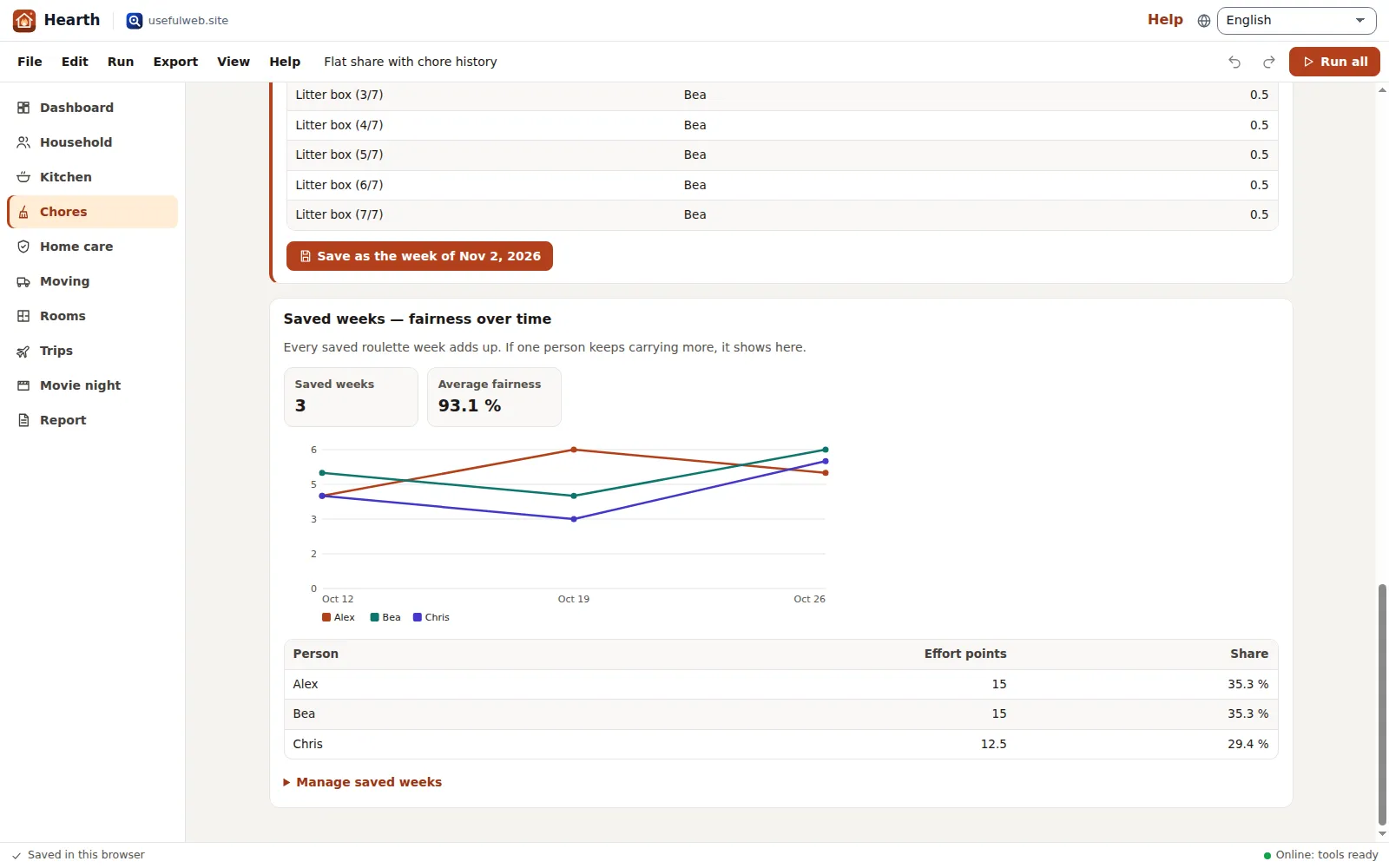
Every saved week adds up in Saved weeks — fairness over time: a line per person with effort points per week, the Average fairness and each person’s Share of all saved effort. If one person carries noticeably more than an even share, the dashboard says so in plain words.
Remove a wrongly saved week under Manage saved weeks.
Tips
- Use effort points for how unpleasant a chore is, not just how long it takes — a 10-minute litter box can be worth more than 10 minutes of dusting.
- Take a snapshot (Edit → Take snapshot) each month to compare the average fairness later.
Ready to try it?